Destination EV Charging: The Business Opportunity for UK Retail and Hospitality
.jpg)

With 1.75 million battery electric vehicles now on UK roads and the fleet having quadrupled in just four years, destination charging represents one of the most significant opportunities for retail and hospitality businesses to attract high-value customers and generate additional revenue.
This guide examines the commercial case for destination EV charging, backed by verified industry research and data from leading sources including Zapmap, the Department for Transport, and major charging network operators.
The Growth of UK EV Ownership
The UK's electric vehicle market has seen extraordinary growth. According to Zapmap data from November 2025, there are now over 1.75 million battery electric vehicles registered in the UK, representing more than a four-fold increase since the end of 2021.
This rapid expansion shows no signs of slowing. Government targets require 80% of new car sales to be zero emission by 2030, and the current trajectory suggests the UK will have several million EVs on the road within the next five years.
The EV Driver Profile
The early adopters of EVs represent an attractive customer demographic for businesses. According to DfT research, 21% of EV drivers report a household income exceeding £83,001, making them the largest single income bracket among electric vehicle owners. This positions EV drivers as a high-value customer segment with significant spending power.
Understanding Destination Charging
Destination charging refers to EV charging infrastructure located where drivers spend extended periods, such as hotels, restaurants, retail centres, leisure facilities, and workplaces. Unlike rapid charging hubs designed for quick top-ups during journeys, destination chargers are typically slower (7-22kW) and cater to vehicles parked for an hour or more.
Government statistics confirm that destination charging represents the largest category of UK public charging infrastructure. As of January 2025, 49% of all publicly available charging devices in the UK are classified as destination charging, accounting for nearly 36,000 charge points. You can explore Zest's network of charging station locations to see examples of destination charging in practice.
The Commercial Case for Retailers
Dwell Time and Spending
The relationship between customer dwell time and spending is well established in retail research. Path Intelligence's analysis found that a 1% increase in dwell time correlates with a 1.3% increase in sales, a finding widely cited across the retail analytics industry.
Savills and Ellandi's research into UK shopping centres provides more granular insight: non-grocery retail spend doubles when visits exceed one hour and quadruples for visits over two hours. This research, based on a national exit survey of 7,800 shoppers, demonstrates the significant revenue potential of extended customer visits.
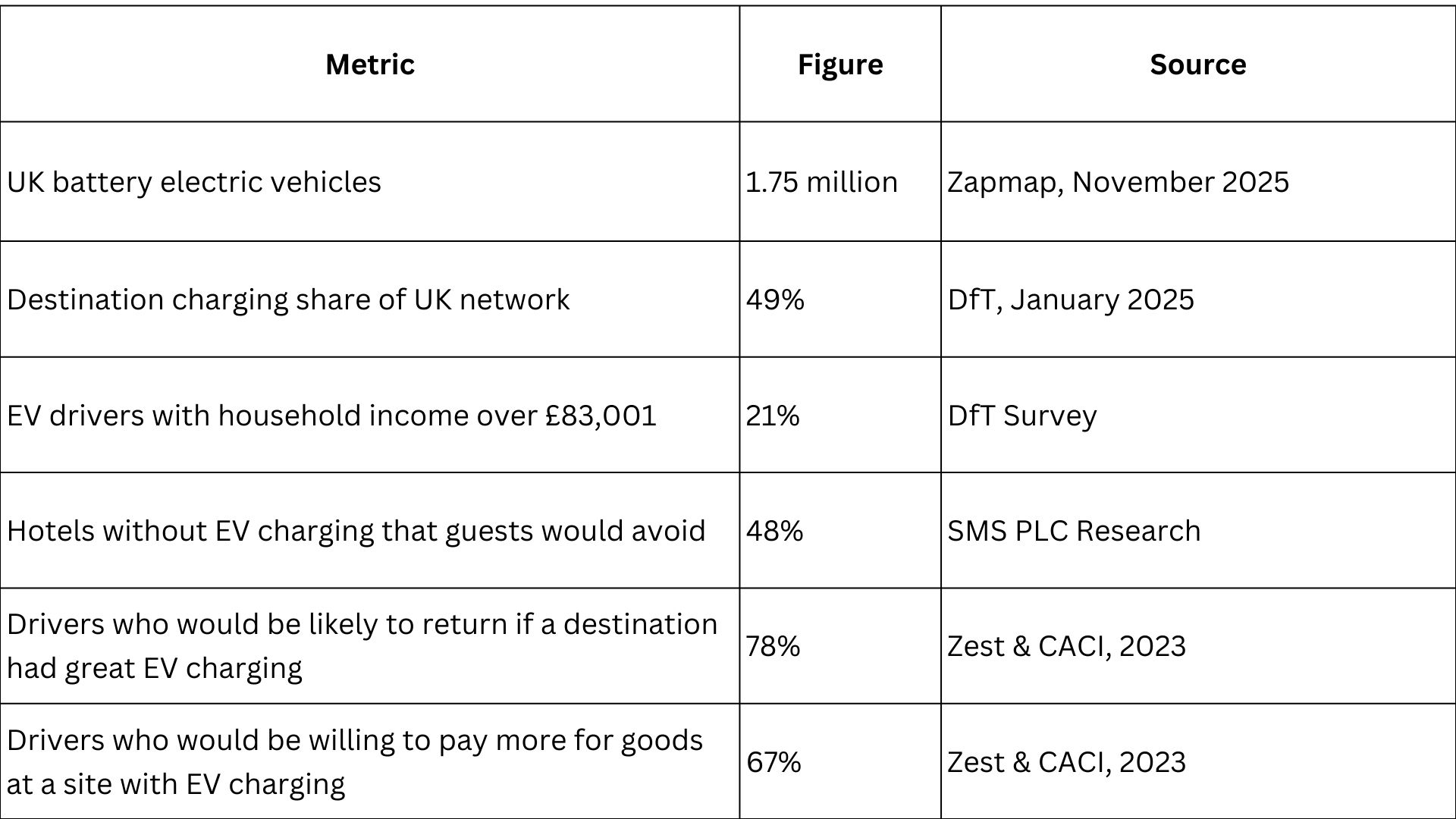
Key Statistics at a Glance
Attracting New Customers
EV charging doesn't just retain existing customers longer; it actively attracts new ones. Zest-commissioned research with CACI indicated that 82% of EV drivers would be willing to travel between 6 and 30 minutes longer to reach a destination with EV charging, which has the potential to boost trip value by 23%. This behaviour pattern makes EV drivers particularly valuable customers for destination businesses. For more on how leisure, retail and hospitality businesses benefit from EV charge points, see our detailed guide.
The Hotel Sector Opportunity
Current Provision Gap
Despite strong demand, hotel EV charging provision remains severely limited. This represents a significant gap between supply and demand.
Regional variations are stark. St Davids in Wales leads with 22% of hotels offering charging, while major cities and tourist destinations lag far behind. This disparity creates both a challenge for EV-driving guests and an opportunity for forward-thinking hoteliers. Learn more about why EV charging is becoming essential for hotel success.
Guest Expectations and Behaviour
SMS PLC's comprehensive hospitality research, surveying over 1,000 UK EV drivers in September 2023, revealed the critical importance of charging to booking decisions:
- 67% of EV drivers factor charging availability into their hotel choice
- 48% would not book a hotel without EV charging facilities
- 83% are prepared to wait for a charger to become available
- 77% would pay for a concierge-style vehicle moving service to optimise charger availability
These findings demonstrate that EV charging has moved from a nice-to-have amenity to a key decision factor for a substantial portion of hotel guests. For a deeper look at the guest experience angle, read more than a parking space: how EV charging can enhance the hotel experience.
The Cost of Inaction
With EV adoption continuing to accelerate, this revenue gap will only widen. Hotels that invest in charging infrastructure now will be well-positioned to capture this growing market segment. See how EV charging can boost hospitality's competitive edge.
.jpg)
Charging Costs and Pricing
Understanding the current charging landscape helps businesses position their offering competitively. The Zapmap Price Index for November 2025 shows average public charging costs of 52p per kWh for slow and fast chargers (up to 49kW).
Destination charging typically offers competitive pricing compared to rapid charging, making it attractive for EV drivers who have time to charge while engaged in other activities. Many businesses choose to offer free or subsidised charging as a customer attraction tool, recovering the cost through increased footfall and spending.
Bottom Line
The evidence is clear: destination EV charging represents a significant commercial opportunity for UK retail and hospitality businesses. With nearly half of all public charging infrastructure already classified as destination charging, and EV adoption continuing to accelerate, businesses that invest in charging facilities now will be well-positioned to attract high-value customers.
The combination of extended dwell times, increased spending, new customer acquisition, and competitive differentiation makes a compelling case for action. For hotels in particular, where nearly half of EV drivers report they won't book without charging, the question is not whether to install chargers, but how quickly to do so.
Ready to explore destination charging for your business? Contact Zest to discuss how we can help, or learn more about us.
.png)