Hotel EV Charging Stations: A Practical Guide for UK Hotel Chains

Hotel EV charging stations give guests a convenient way to charge while they stay, and hotel operators another amenity to promote. Hotels are well suited to destination charging because guests often leave their cars parked overnight. For hotel groups, the opportunity is not simply to install chargers, but to create a reliable offer that meets the needs of different properties.
More than 4,100 UK charging devices were associated with hotels and similar accommodation in June 2026, according to Zapmap. Yet provision remains uneven. The right approach depends on the type of hotel, its parking facilities, guest profile and whether it attracts visitors beyond overnight residents.
Why hotel EV charging stations matter
EV drivers plan charging around where they spend time. A hotel stay creates a natural opportunity: guests can connect their vehicle when they arrive and leave it charging while they eat, sleep or use the hotel's facilities, rather than making a separate trip to a charging hub.
That convenience can influence where guests choose to stay, particularly when travelling longer distances or visiting somewhere without convenient public charging nearby. Charging does not need to be the main reason someone books a room to be a useful factor in their decision.
In its November 2026 audit of 2,888 properties across 30 major UK chains, EV Cable Hub found that 844 had on-site charging – 29.2% of the properties reviewed. That was up from 21.6% in its 2025 audit, but most chain hotels surveyed still did not offer charging. For hotel groups, this points to scope to improve the guest offer and differentiate individual properties.
The advantage of overnight hotel EV charging
Hotels have a different charging use case from supermarkets, retail parks or roadside services. Guests often park for several hours, making slower AC destination charging a practical option.
A vehicle connected for eight to twelve hours can gain a significant amount of energy from an AC charger, depending on its output and the vehicle's onboard AC charging capability. Guests can start the next day with more range, without needing to find a separate charging stop during their journey.
Hotels should not promise that every vehicle will be fully charged by morning. The amount of energy added depends on the vehicle, its starting battery level, charger output and time connected. The key benefit is convenience, not maximum charging speed. A well-planned number of AC spaces may serve overnight guests more effectively than rapid chargers they do not need.
Charging can help hotels stand out when guests book
EV charging can influence a hotel's visibility during the booking process. Knight Frank's UK Hotel Trading Performance Review 2025 notes that major online travel agency websites offer filters to identify hotels with EV charging. This means charging can affect whether a property appears in a filtered search before a potential guest compares its rooms, location or other amenities.
Hotel groups should keep information accurate across their own booking websites, central reservations teams, property pages, online travel agencies and EV charging maps.
Simply stating that a hotel has EV charging is not enough. Guests need to know how many spaces are available, whether they can reserve one, charger type and speed, whether they need to bring a cable, how payment works and whether parking charges apply.
The details matter. EV Cable Hub's 2026 audit found that only 9.2% of hotels with chargers allowed guests to reserve a space in advance. It also found that 82.6% of hotel charge points surveyed had no cable attached. Clear information can prevent frustration for guests who arrive expecting to plug in without their own Type 2 cable.
Choosing the right hotel EV charging stations
There is no single charger type that suits every hotel. The right mix depends on how long vehicles are parked, the facilities on site and the electrical capacity available.
AC charging for overnight guests
AC chargers, commonly rated between 7kW and 22kW, are generally well suited to overnight stays. They provide a steady charge over a longer period and can allow several vehicles to charge while guests are in their rooms.
Rapid charging for shorter visits
DC rapid chargers, typically 50kW or above, may be more appropriate where a hotel also attracts non-resident visitors. This could include people visiting a restaurant, spa, golf course or conference centre. If they are only on site for an hour or two, a faster charge may be more useful.
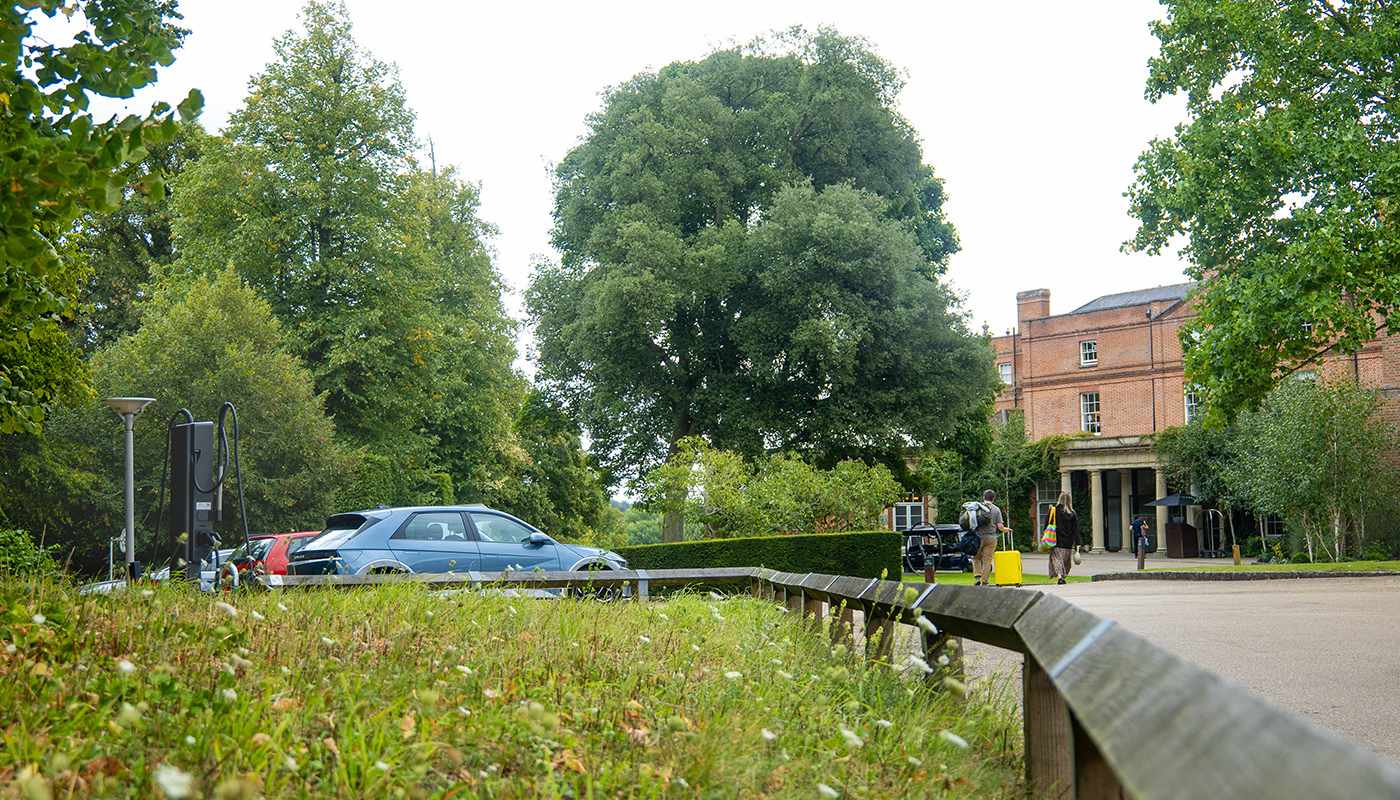
The Grove Hotel in Hertfordshire illustrates how a mixed approach can work. Its Zest charging provision includes four 22kW AC spaces and two 50kW DC rapid spaces, offering different options for guests and other visitors. See The Grove's charging facilities.

Plan for the property, not just the charger
Before deciding on a specification, hotels should consider parking capacity and layout, typical occupancy, length of stay, daytime visitor numbers and available electrical capacity. It is also worth considering whether the installation can be expanded as demand grows.
A city-centre hotel with limited parking may have different requirements from a countryside resort with a large car park and leisure facilities. The aim is to provide enough charging in the right places while making sensible use of the site's power supply and investment.
Which hotel chains have EV charging in the UK?
Charging provision varies considerably between hotel groups. EV Cable Hub's November 2026 audit found particularly high coverage among some upscale and full-service brands, while several budget chains had more limited provision.
According to the audit, Village Hotels had charging at 90.9% of its properties, followed by De Vere (88.9%) and Warner Hotels (85.7%). Provision was also relatively high across the Marriott Hotels (76.1%) and Hilton Hotels & Resorts (71.1%) properties included in the research.
However, coverage was considerably lower among some of the UK's largest budget hotel chains. Premier Inn had charging at 204 of its 850 hotels (24%), while Travelodge had facilities at just 54 of its 600 properties (9%).
These figures, based on an audit of 30 major hotel chains, highlight the variation in how the sector is approaching EV charging. While some groups have made significant progress, there is still considerable scope for wider adoption, particularly among budget hotels with large property portfolios.
For hotel groups, the opportunity is to consider how charging could become a more consistent part of their offering, making it easier for EV drivers to choose where they stay.
Should hotel chains and independent hotels take different approaches?
For hotel chains, EV charging is best considered as part of a wider estate strategy. A group can assess its portfolio, identify where charging is most viable and establish common expectations for charger quality, payment, customer support and maintenance.
A phased rollout can help. Starting with selected properties allows the group to understand usage, guest feedback and operational requirements before expanding. Consistency should be in the guest experience, not necessarily the hardware: a resort with extensive parking may need a mix of AC and rapid charging, while a city hotel may need only a few destination chargers.
Independent hotels are more likely to take a site-specific approach, weighing up their parking layout, guest profile and budget. A fully managed arrangement can be useful where the hotel wants to offer charging without taking on technical and operational responsibility itself.
Zest's project with Talland Bay in Cornwall illustrates this model. Zest invested in, operated and maintained the charging facilities, providing the hotel with charging without the associated installation costs or day-to-day operational overheads. Read about the Talland Bay project.
How to plan a hotel EV charging rollout
A successful rollout starts with understanding the needs of your guests and finding the right partner to deliver the infrastructure. Here are six key considerations:
1. Understand guest needs. Review typical length of stay, occupancy, parking use and the likely proportion of guests arriving in EVs. Include day visitors if the hotel has restaurants, leisure or conference facilities. Consider how growing EV adoption could influence demand over the coming years.
2. Identify suitable locations. Consider where charging spaces would work best within your car park, taking into account guest access, parking arrangements and how the spaces will be used. Your charging partner can then assess the site's electrical capacity, grid connection requirements and installation options.
3. Find the right charging solution. Work with your charging partner to determine the most appropriate mix of AC and rapid chargers for your property. This should reflect how long guests typically park, expected demand and whether the facilities will also serve day visitors.
4. Decide on access and pricing. Consider whether charging will be complimentary, paid for by guests or included in a room package. Decide whether facilities will be reserved for hotel guests or open to other drivers, and whether guests should be able to reserve a charging space in advance.
5. Choose an operating and maintenance model. Consider how the charging infrastructure will be funded, installed, operated and maintained. A fully managed solution can remove the need for hotel teams to take on the technical and ongoing operational responsibilities themselves.
6. Promote the facilities and monitor performance. Make sure charging information is available across your website, booking platforms and other guest communications. Monitor usage, availability and customer feedback to understand how well the facilities are meeting demand and where further investment might be worthwhile.
Where charge points are open to the public, operators should also understand the UK Public Charge Point Regulations 2023. These cover payment, pricing transparency, reliability and customer support, and apply to publicly accessible charge points, including those offering free charging.
Hotel EV charging FAQs
What type of EV charger is best for a hotel?
For many hotels, 7kW to 22kW AC chargers are a good fit for guests who park overnight. DC rapid chargers may be more suitable where the hotel attracts shorter-stay visitors or drivers travelling along nearby routes. The right choice depends on dwell time, demand and electrical capacity.
Can hotel guests reserve an EV charging space?
Some hotels allow reservations, but this is not yet common. EV Cable Hub's 2026 audit found that only 9.2% of hotels with chargers offered advance reservations. Hotels should make their policy clear and consider whether reserving a space would improve the guest experience.
Do hotels need to offer free EV charging?
No. Hotels can offer charging free of charge, include it in a room package or charge guests separately. The decision should account for electricity and operating costs, guest expectations and the hotel's commercial approach. Clear pricing information is essential..
Make charging part of the hotel experience
Hotel EV charging works best when it is planned around how people use each property. Overnight guests often need convenient AC charging, while hotels with leisure facilities or shorter-stay visitors may benefit from a mix that includes rapid charging. For hotel groups, a clear estate-wide strategy can provide a consistent guest experience while allowing each site to have the infrastructure it needs. Start by understanding demand, assessing the property and making the charging offer reliable and easy to use.