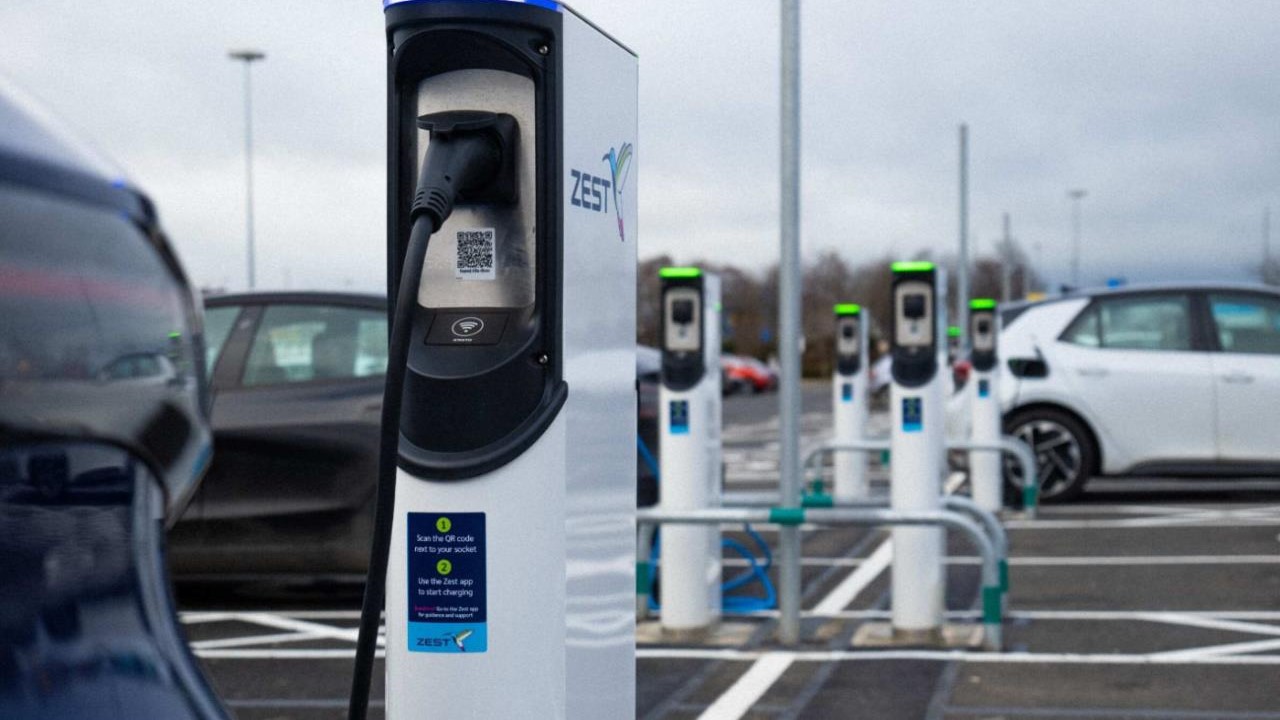
Types of EV Chargers Explained: Standard, Standard Plus & Rapid Charging
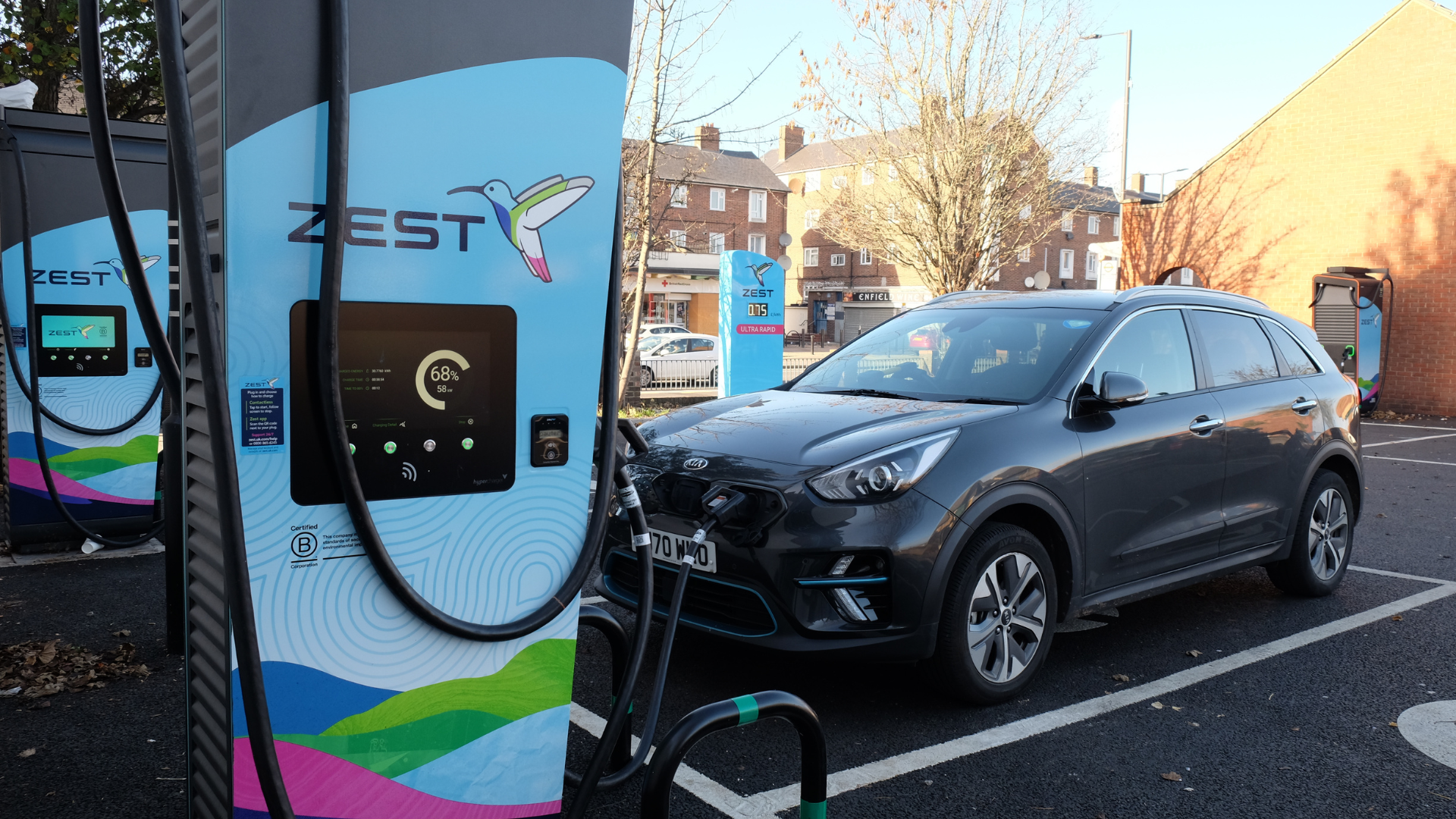

Choosing the right EV charger should not feel complicated, but the terminology around charging speeds can make it harder than it needs to be. From Standard and Standard Plus to Rapid and Ultra-Rapid, each charger type has a different role to play depending on where you are, how long you are parked, and how quickly you need to get back on the road.
For many drivers, the fastest charger is not always the most practical option. A Standard charger can be ideal when a car is parked overnight, Standard Plus charging can work well during a shopping trip or working day, while Rapid and Ultra-Rapid chargers are designed for shorter stops on longer journeys.
Understanding the difference helps drivers plan more confidently and helps businesses, destinations and local authorities provide charging that genuinely fits how people use a location. The best charging experience is not just about power; it is about matching the charger to the journey.
This guide explains Standard, Standard Plus, Rapid and Ultra-Rapid EV charging, including where each type is used, how long charging can take, which connectors are common in the UK, and how to decide what works best for your journey.
In the UK, public EV charger speed categories are increasingly described as Standard, Standard Plus, Rapid and Ultra-Rapid. These terms are more useful than older labels such as “slow” and “fast”, because lower-powered charging is not necessarily a poor option. It is often exactly what drivers need when the car is parked for several hours.
The right charger depends on dwell time. If the car is parked overnight, Standard charging can work well. If it is parked for a few hours at work, a supermarket, a hotel or a leisure venue, Standard Plus charging may be a good fit. If the driver is travelling and needs to continue quickly, Rapid or Ultra-Rapid charging is more suitable.
What is Standard EV charging?
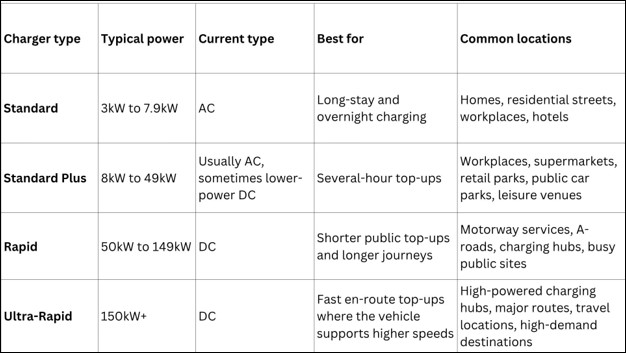
Standard EV charging usually covers lower-powered AC charging from around 3kW to 7.9kW. It is the type of charging many drivers use at home, on residential streets or in places where the car will be parked for a long period.
A dedicated 7kW home wallbox is a common example. It is far more practical than relying on a domestic three-pin plug, which is generally best kept for occasional or emergency use. A three-pin socket can charge an EV, but it is much slower and is not the recommended everyday option for most drivers.
Standard charging works because the car is already parked. A driver may plug in at home after work, charge overnight, and wake up with enough range for the next day. For drivers without driveways, well-placed residential and on-street chargers can provide a similar routine close to home.
What is Standard Plus EV charging?
Standard Plus charging sits between everyday Standard charging and high-powered Rapid charging. It typically ranges from 8kW to 49kW. Many Standard Plus chargers use AC power, although some lower-powered DC chargers can also fall into this speed band.
This type of charger is useful where drivers are parked for a few hours rather than a few minutes. Common examples include workplaces, supermarkets, retail parks, hotels, restaurants, gyms, leisure centres and town-centre car parks.
The important point is that drivers do not usually wait beside the charger. They charge while doing something else. A two-hour shopping trip, a working day at the office, or an overnight hotel stay can all become useful charging opportunities.
For Zest, this is where infrastructure planning becomes important. Charging should be matched to how people use a location. A retail park does not necessarily need every charger to be Ultra-Rapid. A mix of Standard Plus and Rapid options may better reflect how long drivers stay and what they need from that visit.
What is Rapid and Ultra-Rapid EV charging?
Rapid charging is designed for shorter stops. In the UK, Rapid chargers are usually rated from 50kW to 149kW. Ultra-Rapid chargers are rated from 150kW upwards, with some high-powered units reaching 300kW or 350kW.
These chargers use DC power, which means the charger converts electricity before it reaches the vehicle battery. This allows much higher power delivery than AC charging, where the car’s onboard charger handles the conversion.
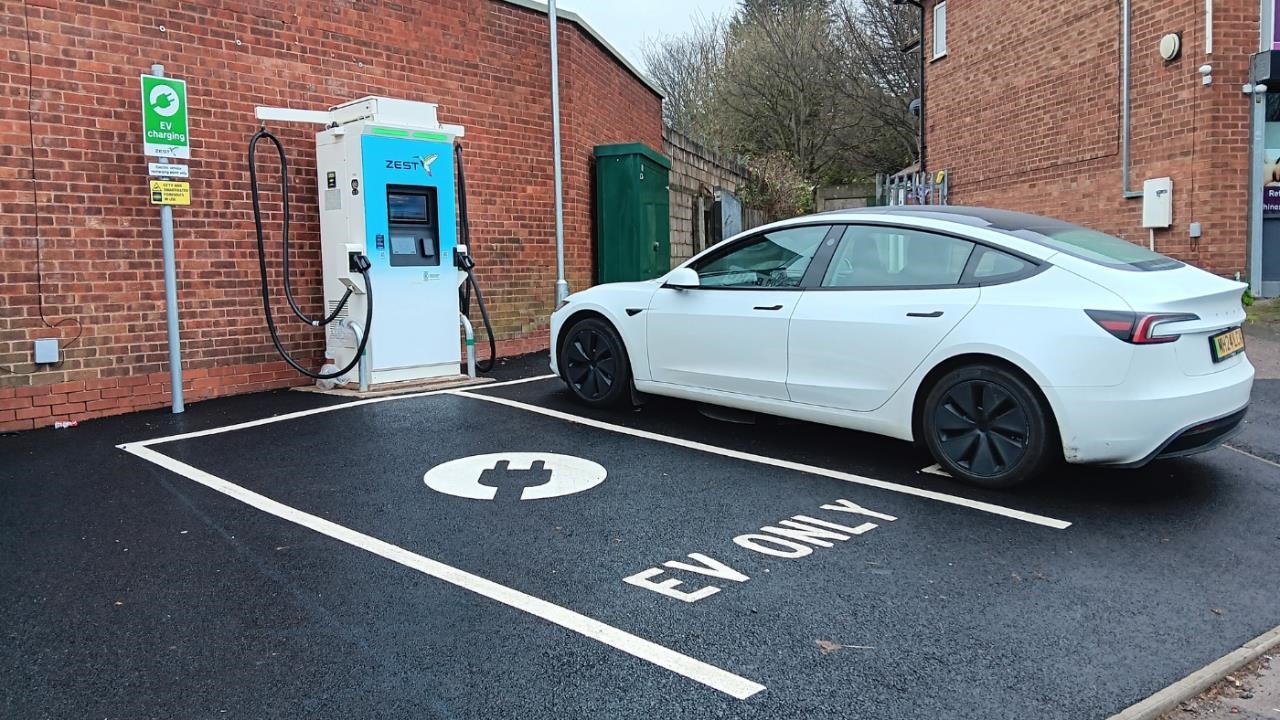
Rapid and Ultra-Rapid charging is most useful on longer journeys, when a driver needs to add range quickly and continue. You will typically find these chargers at motorway service areas, major A-roads, dedicated charging hubs, transport locations and high-demand public sites.
Charging speed still depends on the vehicle. Plugging into a 350kW charger does not mean every EV will charge at 350kW. The car has its own maximum charging rate, and the battery management system controls charging speed throughout the session.
For further context on why EV charging terminology is changing, Zapmap’s 2026 reporting standards explain the move from older labels such as “slow” and “fast” to clearer terms like Standard and Standard Plus. The article also outlines why EV chargers are now being used as the lead metric for measuring public charging provision, helping drivers and the industry better understand how many vehicles can charge at the same time.
Why EV charging slows after 80%
EV charging is not constant from empty to full. Rapid charging is usually fastest when the battery is lower, often between around 10% and 80%. After that, the vehicle slows the charging rate to protect the battery.
This is why public Rapid and Ultra-Rapid charging times are often quoted for a 10% to 80% charge rather than 0% to 100%. For long journeys, it is often much quicker to stop, charge to around 80%, and continue rather than waiting for the final 20%.
AC vs DC charging: what is the difference?
AC stands for alternating current. This is the type of electricity supplied by the grid. With AC charging, the vehicle converts electricity into the DC power stored in the battery. Standard and many Standard Plus chargers use AC.
DC stands for direct current. With DC charging, the charger handles the conversion before power reaches the vehicle. This is why Rapid and Ultra-Rapid chargers can deliver much higher charging speeds.
For drivers, the practical difference is simple: AC charging suits longer parking sessions; DC charging suits shorter stops when speed matters.
EV connector types in the UK
EV connector types can seem complicated, but most UK drivers only need to understand a few key options. The connector you use depends on the vehicle, the charging speed and whether the charger supplies AC or DC power. In most modern EVs, Type 2 is used for everyday AC charging at home, work and many public destinations, while CCS is the main standard for Rapid and Ultra-Rapid DC charging. Older connectors, including CHAdeMO and Type 1, are still available in some places but are now more commonly linked to older or imported vehicles.
The RAC’s visual guide provides a helpful overview of the different electric car charger types and connectors available in the UK.
Connector types can look confusing at first, but the UK picture is becoming more standardised. For most modern EVs, there are two connectors drivers need to understand: Type 2 and CCS.
Type 2
Type 2 is the standard connector for most AC charging in the UK and Europe. It is used for home wallboxes, workplace chargers and many public Standard or Standard Plus chargers. Some public AC chargers have a tethered cable, while others are socketed, meaning drivers need to bring their own Type 2 cable.
CCS
CCS, or Combined Charging System, is the main connector used for Rapid and Ultra-Rapid DC charging in the UK. Most modern EVs support CCS for public high-powered charging. Rapid and Ultra-Rapid chargers usually have tethered cables, so drivers do not need to bring their own cable for these sessions.
CHAdeMO and Type 1
CHAdeMO is still found on some older EVs, including earlier Nissan Leaf models, but it is less common on newer vehicles. Type 1 is also mainly associated with older or imported models. Most new UK EV drivers will use Type 2 for AC charging and CCS for Rapid DC charging.
How long does each type of EV charger take?
Charging time depends on four main factors: the power of the charger, the battery size, the car’s maximum charging capability and the battery level at the start of the session. Weather, battery temperature and how many vehicles are using nearby infrastructure can also affect real-world performance.
A simple estimate is: charging time equals energy needed divided by charger power. For example, if a 60kWh battery needs to charge from 20% to 80%, it needs around 36kWh of energy. On a 7kW Standard charger, that would take roughly five hours before allowing for efficiency losses and charging behaviour.
Typical UK charging times can be summarised as follows: Standard charging can take overnight or longer; Standard Plus charging can add meaningful range over a few hours; Rapid charging is commonly used for shorter 10% to 80% top-ups; and Ultra-Rapid charging can be quickest where the vehicle supports higher charging speeds.
Step-by-step: how to choose the right EV charger for your journey
Start with where the car will be parked. If the car will be parked overnight, Standard charging is usually suitable. If it will be parked for a few hours, Standard Plus may be more useful. If you are stopping briefly on a long journey, look for Rapid or Ultra-Rapid charging.
Match charging speed to dwell time. A charger should suit the time available. The fastest option is not always needed if the car is parked for several hours.
Check your connector. Most modern UK EVs use Type 2 for AC charging and CCS for Rapid DC charging.
Check what your car can accept. Your EV sets its own maximum charging speed, so a higher-powered charger will not always mean a faster session. Think in top-ups, not full charges. Most EV drivers add the range they need instead of routinely charging from empty to full.
How EV drivers use different charger types in real life
Most EV drivers use a combination of charger types. Standard charging often covers routine needs at home or close to home. Standard Plus charging supports useful top-ups at destinations. Rapid and Ultra-Rapid charging provide confidence for longer journeys.
Addressing the myth: “Public charging is only for motorway journeys”
Rapid and Ultra-Rapid chargers are important for long-distance travel, but public charging is much broader than motorway stops. Standard and Standard Plus chargers at workplaces, supermarkets, retail parks, hotels, leisure venues, residential streets and town-centre car parks help drivers charge during normal daily activities. For many people, especially those without off-street parking, these everyday charging locations are the most useful part of the public network.
A checklist for choosing the right charger
- Start with where the car will be parked. If the car will be parked overnight, Standard charging is usually suitable. If it will be parked for a few hours, Standard Plus may be more useful. If you are stopping briefly on a long journey, look for Rapid or Ultra-Rapid charging.
- Match charging speed to dwell time. A charger should suit the time available. The fastest option is not always needed if the car is parked for several hours.
- Check your connector. Most modern UK EVs use Type 2 for AC charging and CCS for Rapid DC charging.
- Check what your car can accept. Your EV sets its own maximum charging speed, so a higher-powered charger will not always mean a faster session.
- Think in top-ups, not full charges. Most EV drivers add the range they need instead of routinely charging from empty to full.
.png)