How Do EV Charging Stations Work?
.jpg)

The UK's electric vehicle charging infrastructure is undergoing rapid transformation. From residential lamp-post chargers to megawatt commercial hubs, the technology enabling this network represents some of the most sophisticated power-electronics engineering in the automotive sector. Understanding how these systems work reveals why certain installation types suit different locations and use cases.
For those looking to understand charging options in their area, Zest's charging station locator provides a comprehensive map of available infrastructure across the UK.
Understanding Charging Levels
EV charging infrastructure is categorised into distinct levels based on power output and use case. Each level serves different requirements, from overnight home charging to rapid top-ups during long journeys.
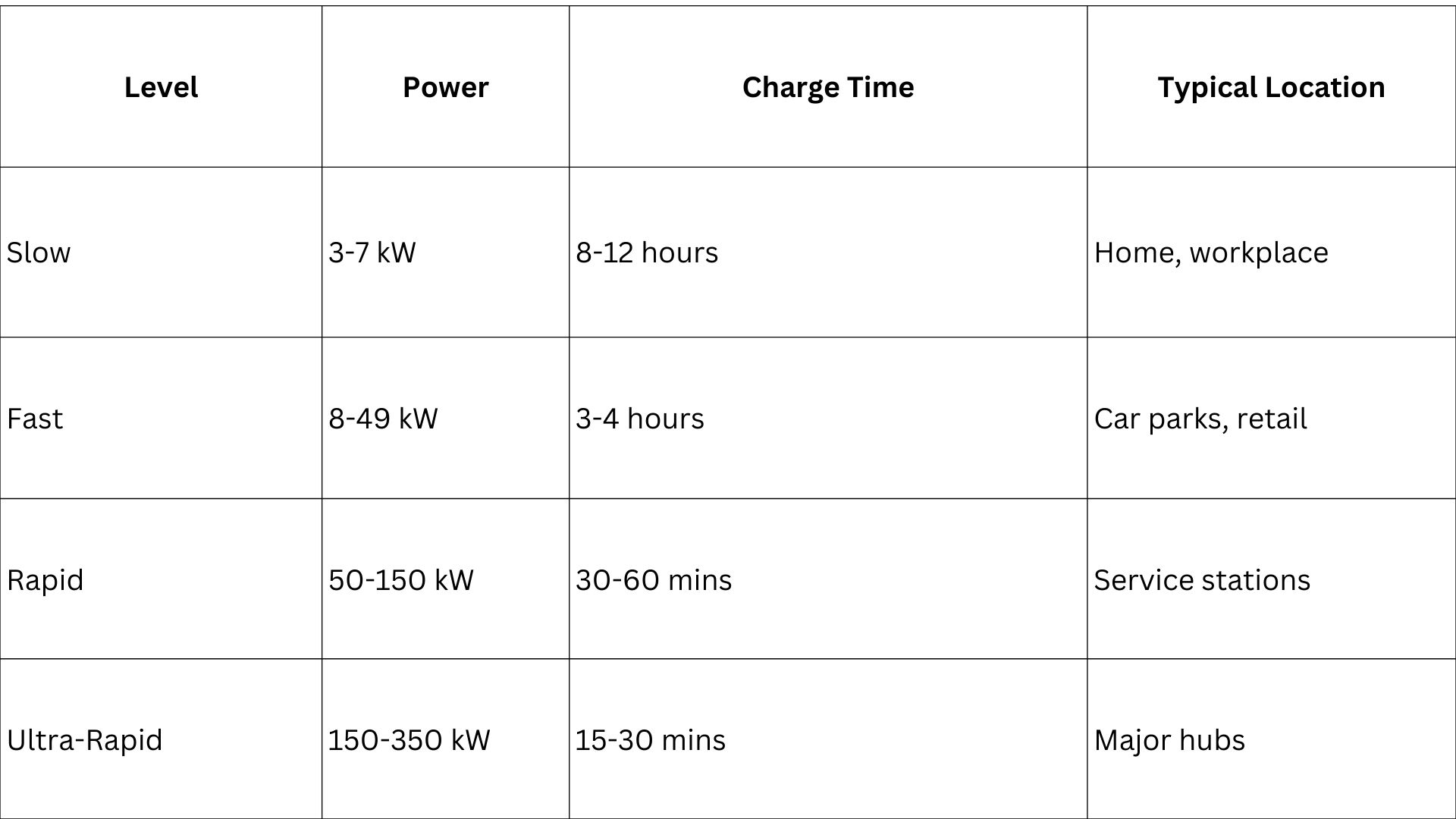
Ultra-rapid charging infrastructure is being deployed across the UK at major retail destinations and transport hubs, enabling drivers to add significant range during short stops.
AC vs DC Charging: The Core Difference
The fundamental distinction in EV charging lies between alternating current (AC) and direct current (DC) systems. This difference affects everything from installation costs to charging speeds.
How AC Charging Works
When you connect to an AC charger, the following process occurs:
- Grid AC power flows to the charging station
- The charger passes AC to the vehicle's onboard charger
- The onboard charger converts AC to DC
- DC power charges the battery pack
- Battery management system regulates the charge
The onboard charger's capacity limits AC charging speed. Most vehicles include 7 kW or 11 kW onboard chargers, with some premium models offering 22 kW capability.
How DC Charging Works
DC rapid chargers bypass the vehicle's onboard charger entirely. The charging station contains heavy duty power electronics that convert grid AC to DC before delivering it directly to the battery. This enables much higher power delivery, with modern units reaching 350 kW and beyond.
Organisations considering workplace charging installations can learn more about implementation through Zest's guide to EV charging infrastructure.
Charger Hardware and Environmental Protection
Commercial charging equipment must withstand varied environmental conditions while maintaining electrical safety. The Ingress Protection (IP) rating system indicates how well units resist dust and water penetration.
.jpg)
The Combined Charging System (CCS) connector used across Europe supports power delivery up to 500 kW under the current standard (1000V, 500A), with liquid cooled cables rated for 500A continuous operation. Higher power implementations reaching 600A to 800A are emerging for next generation infrastructure.
UK Regulatory Framework
Two major regulatory changes have significantly impacted UK charging infrastructure development: the Access Significant Code Review (Access SCR) and the Public Charge Point Regulations 2023.
Access SCR (April 2023)
Ofgem's Access SCR fundamentally changed how grid connection costs are allocated, making large scale charging infrastructure significantly more viable:
- Demand customers no longer pay for upstream reinforcement costs (shallow connection boundary)
- Generation customers pay reinforcement only at their connection voltage level
- High cost threshold set at £1,720 per kVA for demand connections
- Real world impact demonstrated in projects like an Inverness fleet charging hub, where customer costs dropped from £640,000 to £130,000
Public Charge Point Regulations 2023
These regulations, effective from November 2024 for rapid chargers (50kW+), establish minimum standards for public charging:
- 99% reliability requirement measured as a network average across the calendar year
- Contactless payment mandatory on all new rapid charge points
- Transparent pricing clearly displayed before charging commences
- Open data provision through standardised OCPI protocols
- Penalty structure: £10,000 per network for reliability failures; £10,000 per chargepoint for payment, pricing and data requirement failures
Digital platforms like UK Power Networks' Smart Connect have streamlined the connection process, with 73% of applications auto approved within seconds. Learn more about how local authorities are facilitating EV infrastructure.
Emerging Technologies
Megawatt Charging System (MCS)
Developed by CharIN (Charging Interface Initiative), the MCS standard targets heavy duty commercial vehicles requiring rapid turnaround times. Key specifications include:
- Maximum power: 3.75 MW (3,000A at 1,250V DC)
- Target vehicles: Class 6-8 trucks, buses, heavy freight
- Standards: IEC 63379, SAE J3271 (expected 2025)
- Cooling: Mandatory liquid cooling for high current delivery
- Initial deployment: Milence network planning 1,700 charging points across Europe by 2027
Plug and Charge (ISO 15118)
ISO 15118 enables automatic vehicle identification and payment authentication:
- ISO 15118-2 (2014) introduced foundational Plug and Charge functionality
- ISO 15118-20 (April 2022) adds bidirectional charging (V2G), wireless support, and TLS 1.3 security
- PKI based certificate authentication eliminates need for cards or apps
- Growing adoption: Porsche Taycan, Mercedes EQS, Ford Mach-E, BMW i series, VW ID models
In the UK, IONITY currently offers the only public network supporting ISO 15118 Plug and Charge, though adoption is expanding.
Wireless Charging
Inductive charging technology is progressing from trials to commercial deployment:
- Efficiency: 90-93% grid to battery (comparable to Level 2 wired charging at 88-95%)
- Power levels: Up to 11 kW currently, scalable to 20 kW+
- Weather resistance: Confirmed operational in snow, ice, rain, and with minor misalignment
- UK deployment: Nottingham WiCET trial completed with nearly 1,000 charging events across 20+ taxi drivers
The Nottingham wireless taxi trial, funded by OZEV through Innovate UK, demonstrated the practicality of in-rank wireless charging. Drivers reported appreciation for the convenience and time savings, though feedback indicated desire for faster charging rates.
%20(1).jpg)
Infrastructure Deployment Challenges
The National Audit Office's December 2024 report confirmed the UK is on track for 300,000 public charge points by 2030, with 64,632 installed as of July 2024. However, significant challenges remain.
Regional Distribution
- 44% of chargepoints are concentrated in London and the South East
- Only 15% located in rural England
- 38% of motorway service areas still lack sufficient ultra-rapid provision
- Planning and grid connection delays continue to slow rollout
Addressing these gaps requires coordinated effort across sectors. Learn about how regional councils are expanding charging networks and university campus deployments.
Looking Ahead
Chinese manufacturers are already deploying 480-500 kW chargers domestically, with NIO and XPeng leading the charge. These power levels will likely arrive in European markets as 800V vehicle architectures become standard.
The convergence of regulatory support, technological advancement, and growing demand suggests the next five years will see a fundamental transformation in how we power electric transport. For businesses and local authorities considering infrastructure investment, understanding these technical foundations provides the basis for informed decision-making.
For organisations exploring EV charging deployment, contact Zest to discuss infrastructure solutions tailored to your requirements.
.png)