How EV charging works and connector types explained
.jpg)

If you're new to electric vehicles, the terminology around charging can sound intimidating. AC, DC, Type 2, CCS, kW ratings—it's a lot to take in. But here's the truth: you don't need to be technically minded to use public chargers, and the process is far more straightforward than it first appears.
This guide explains exactly what's happening when you plug in, why there are different connector types, and what all those acronyms actually mean. The good news? Zest's network is designed to handle all this complexity for you so that you can charge with confidence from day one.
The Basics: What Happens When You Plug In
At its core, EV charging is straightforward. Your electric vehicle has a large battery pack (think of it like a massive phone battery), and charging is simply the process of transferring electricity from the grid into that battery.
When you connect your car to a charging station, the charger and your vehicle begin communicating immediately. They're checking compatibility, agreeing on the amount of power to transfer, and monitoring the charging process to ensure everything remains safe. This all happens automatically—you don't need to configure anything.
Your car has an onboard charger. This component's job is to convert the incoming electricity into the right type for your battery and manage the charging process. Different charging speeds are simply different levels of power flowing into your battery—like filling a water tank with either a garden hose or a fire hose.
The charger delivers electricity, and your car's systems manage how it's stored. Once your battery reaches the desired level, you simply disconnect and drive. That's all there is to it from a user perspective.
AC vs DC: What's the Difference?
This is where many people get confused, but the concept is actually quite simple. There are two types of electricity used for EV charging: AC (Alternating Current) and DC (Direct Current). Understanding the difference helps you choose the correct charger for your needs.
AC (Alternating Current) Charging
AC is the type of electricity that flows through the national grid and comes out of your home plug sockets. When you use an AC charger, the electricity travels to your car, and then your car's onboard charger converts it to DC (which is what batteries need) before storing it.
AC charging is slower because the conversion happens inside your vehicle, and your onboard charger has size and power limits. Most onboard chargers can handle between 3kW and 22kW, which is why AC charging takes longer.
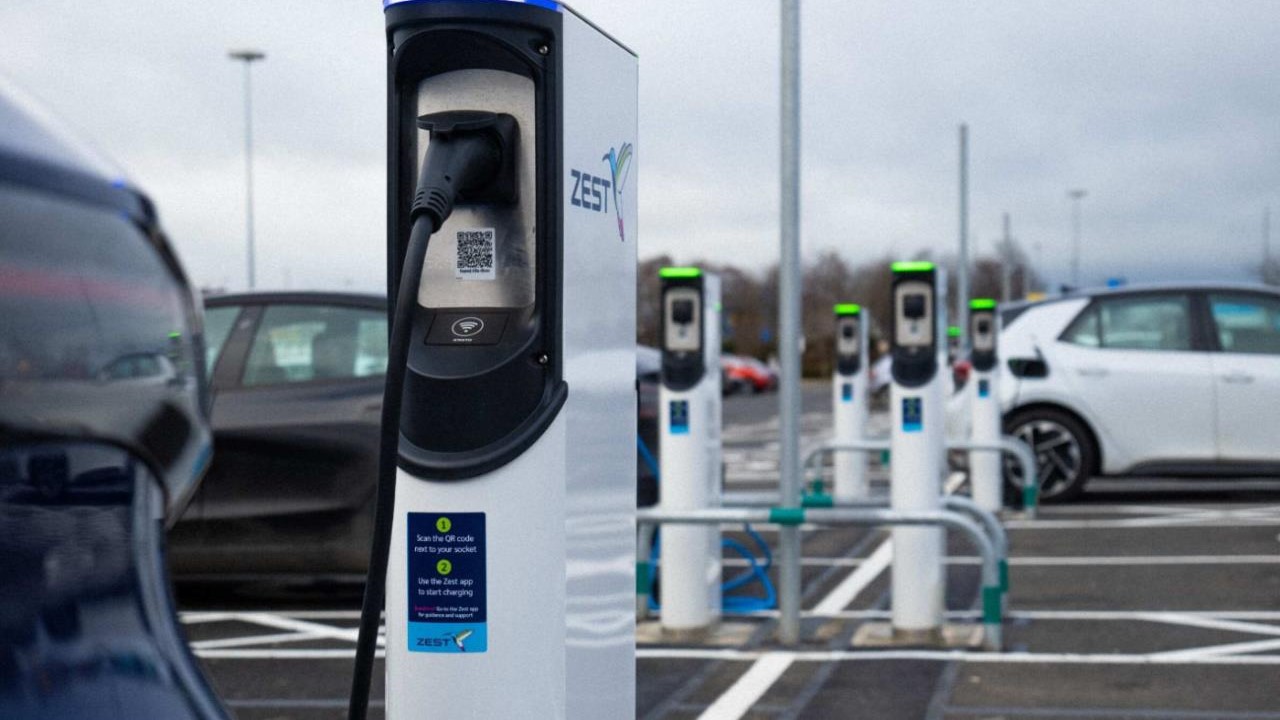
You'll typically find AC chargers at places where you naturally spend a couple of hours or more. Think shopping centres, workplaces, residential streets, and car parks at leisure facilities. They're perfect for topping up whilst you're doing something else.
The Energy Saving Trust offers helpful guidance on choosing between AC and DC charging, tailored to your driving patterns.
DC (Direct Current) Charging
DC chargers convert AC to DC before the electricity reaches your car. This means the power goes straight into your battery, bypassing your vehicle's onboard charger entirely. Because there's no conversion step inside your car, charging happens much faster.
DC charging is used for rapid and ultra-rapid chargers, typically delivering power ranging from 50kW to 300kW. This is what allows you to add a significant range in 20-30 minutes rather than several hours.
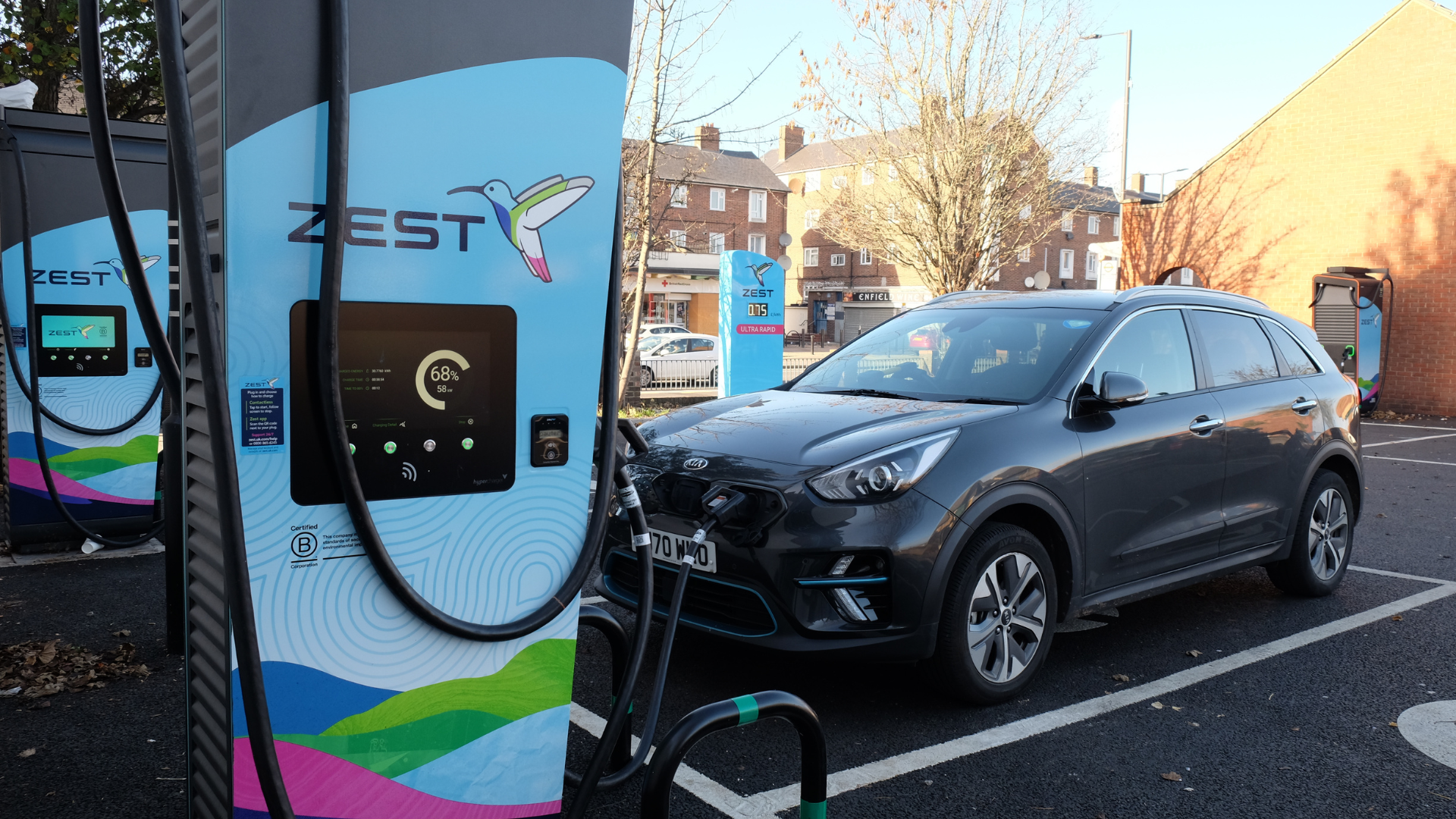
You'll find DC chargers at locations designed for shorter stops, such as motorway services, dedicated charging hubs like those operated by Zest across the UK, drive-thru restaurants, and roadside locations. They're built for drivers who need to charge quickly and get back on the road.
Simple Analogy
Think of AC charging like filling a bottle through a funnel—the funnel (your onboard charger) limits how fast liquid can flow in. DC charging is like pouring straight into the bottle—you're only limited by how fast the bottle itself can accept the liquid.
Both methods charge your battery perfectly well. Neither damages your car when used commonly. They're simply optimised for different situations, and Zest's network offers both AC and DC options at strategically chosen locations.
Understanding Connector Types: Type 2, CCS, CHAdeMO
Now we get to connectors—the actual plugs you use to connect the charger to your car. If you're wondering why there are different types, you're not alone. It's similar to how mobile phone chargers used to be before USB-C became the standard: different manufacturers and regions developed their own systems.
The good news is that the UK and Europe have now standardised. Most modern EVs use the same connector types, which makes public charging far more straightforward than it was a few years ago.
Here's what you need to know about each type:
The Main Connector Types
.jpg)
Type 2 (The Universal AC Connector)
Type 2 has become the standard AC charging connector across the UK and Europe. It has seven pins arranged in a circular pattern and a distinctive D-shaped plug. Virtually every electric vehicle sold in the UK has a Type 2 socket for AC charging.
This is the connector you'll use at slower and fast chargers (3-22kW). Whether you're charging at home with a wallbox, at work, or at a shopping centre car park, you'll almost certainly be using a Type 2 plug. The standardisation means you don't need to worry about compatibility for AC charging.
Type 2 cables are either tethered to the charger (already attached) or you use your own cable that came with your vehicle.
CCS (Combined Charging System)
CCS has become the dominant rapid charging standard for modern EVs. It's called "combined" because it actually combines the Type 2 connector with two additional DC pins below it—so it handles both AC and DC charging through the same socket.
Most EVs manufactured from 2020 onwards use CCS for rapid charging. This includes nearly all major brands: Volkswagen, BMW, Mercedes, Hyundai, Kia, Peugeot, and even newer Tesla models. If you've bought an EV recently, there's a very good chance it has CCS.
CCS supports ultra-fast charging speeds, with some vehicles and chargers capable of 350kW (though most rapid chargers currently offer 50-150kW). Zest operates numerous CCS-equipped rapid and ultra-rapid chargers across major locations, including urban charging hubs and roadside facilities.
CHAdeMO
CHAdeMO is a Japanese charging standard that was popular on earlier electric vehicles, particularly Nissan Leafs produced before 2023. It's a large, round connector quite different from Type 2 or CCS.
Whilst fewer new vehicles use CHAdeMO, there are still many older Leafs on UK roads, so most rapid charging locations maintain CHAdeMO connectors for compatibility. The standard supports speeds up to 100kW, though many older vehicles are limited to 50kW maximum.
If you drive an older Nissan Leaf, you'll have both a Type 2 socket (for AC charging) and a CHAdeMO socket (for rapid DC charging). Check which side of your car each socket is on before you arrive at a charger.
Tesla Connectors
Older Tesla vehicles (Model S and Model X made before 2024) used Tesla's proprietary connector at their Supercharger network. However, newer Tesla Model 3 and Model Y vehicles sold in Europe now use the CCS charging standard, aligning with industry standards.
Tesla owners can use Zest's CCS chargers, and Tesla provides adaptors for older vehicles. The UK Government's EV infrastructure strategy has supported the move toward standardised charging to make public charging accessible for all EV drivers.
Quick Tip: Finding Your Connector Type
Are you unsure which connectors your car has? Check inside your charging port flap—it's usually labelled. Your vehicle handbook will also specify which connector types your car accepts. The Zest app lets you filter charging locations by connector type, so you can find compatible chargers before you set off.
.jpg)
Charging Speeds: Understanding kW Ratings
When you see charging stations advertised by their kW rating (kilowatts), this refers to how fast power flows into your battery. Higher kW means more rapid charging, but your vehicle has maximum rates it can accept, regardless of what the charger offers.
Think of kW like water flow rate. A 7kW charger delivers 7 kilowatts per hour, whilst a 150kW rapid charger delivers 150 kilowatts per hour. The difference in charging time is dramatic:
Typical Charging Speeds
3-7kW (Slow Charging)
- Time for substantial charge: 8-12 hours
- Best for: Overnight charging at home or work
- Where you'll find them: Home wallboxes, workplace car parks, residential streets
7-22kW (Fast Charging)
- Time for substantial charge: 2-4 hours
- Best for: Shopping trips, gym visits, long meetings
- Where you'll find them: Shopping centres, leisure facilities, workplace car parks
50-100kW (Rapid Charging)
- Time to 80%: 20-40 minutes
- Best for: Coffee breaks, quick meal stops
- Where you'll find them: Motorway services, retail parks, roadside hubs
150-300kW (Ultra-Rapid Charging)
- Time to 80%: 15-25 minutes
- Best for: Minimal-wait top-ups on longer journeys
- Where you'll find them: Major travel routes, dedicated charging hubs, drive-thru locations
Important: The 80% Rule
You'll notice charging times reference 80% rather than 100%. This is because EV batteries charge fastest when they're relatively empty and slow down significantly after 80% to protect battery health and longevity.
It's rather like filling a pint glass—you can pour quickly until you reach the top, then you need to slow down to avoid overflow. For rapid charging stops, most drivers charge to 80% and then continue their journey, which maximises efficiency.
Zest's Approach to Charging Speeds
Zest strategically matches charging speeds to location types. Shopping centres typically have fast chargers (7-22kW) because you're there for a couple of hours anyway. Roadside locations and drive-thrus have rapid or ultra-rapid chargers (50-300kW) because you want to charge quickly and move on.
This thoughtful placement means you're not paying premium rapid charging rates when you don't need speed, and you're not waiting around when you do. It's designed around how people actually use different locations.
Will My Car Work with Zest Chargers?
The short answer: almost certainly yes. Zest's network accommodates 99% of electric vehicles on UK roads. Here's a simple checklist to confirm compatibility:
Compatibility Checklist
1. Identify your connector types
- AC charging: Your car definitely has Type 2 (it's universal in UK/Europe)
- DC rapid charging: Check if you have CCS, CHAdeMO, or Tesla connector
2. Check your car's maximum charging speed
- Found in your vehicle handbook or manufacturer's website
- Determines whether you can take full advantage of ultra-rapid chargers
- Don't worry if your car's maximum is lower than the charger offers—it'll just charge at your car's maximum rate
3. Use the Zest app to find compatible chargers
- Filter by connector type to find suitable locations
- See which connectors are available before you travel
- Check real-time availability of specific charging bays
4. Choose charging speed based on your dwell time
- Staying 3+ hours? Fast charger is perfect and cheaper
- Need to charge in 30 minutes? Opt for rapid or ultra-rapid
If You're Unsure
The Zest customer support team can help identify your car's charging requirements. Alternatively, check the manufacturer's website or your vehicle handbook—there's always a section on charging specifications.
For business users and fleet operators, Zest also partners with Allstar to provide seamless charging access across multiple networks, making fleet management simpler.
Common Misconceptions About EV Charging
Let's clear up a few myths that often confuse people new to electric vehicles.
"I need to understand all the technical details to charge my car"
Not really. Your car and the charger communicate automatically and sort everything out between them. You just need to plug in the right cable, and the technology handles the rest. It's far more user-friendly than it sounds on paper.
"If the connector doesn't match, I can't charge"
Technically correct, but most charging locations—including all Zest sites with rapid charging—have multiple connector types available. You'll find Type 2 for AC charging and usually both CCS and CHAdeMO for DC rapid charging. Adaptors are also available for edge cases.
"I should always use the fastest charger available"
Actually, no. Ultra-rapid charging costs more per kWh, and it's unnecessary if you're staying somewhere for a couple of hours. Match the charging speed to your stop duration. You'll save money and still get the charge you need.
The Office for Zero Emission Vehicles provides guidance on efficient EV charging as part of the UK's transition to electric transport.
"AC is better for my battery than DC" (or vice versa)
Neither is inherently "better" for your battery when used normally. Modern EVs are designed to handle both AC and DC charging safely. The battery management system in your car protects the battery regardless of charging method. Use the type that suits your situation.
"I need to wait until my battery is nearly empty before charging"
This is left over from old battery technology (like early mobile phones). Modern lithium-ion EV batteries don't have a "memory effect." You can top up whenever it's convenient without harming the battery. Many EV owners charge opportunistically—adding 20-30% here and there rather than always charging from empty to full.
.jpg)
How Zest Takes the Guesswork Out
At Zest, we've designed our network to make EV charging as straightforward as possible, regardless of your technical knowledge.
What Makes Zest Different
All connector types available: Our rapid charging locations offer Type 2, CCS, and CHAdeMO, so you'll find something compatible with your vehicle.
Clear information before you arrive: The Zest app shows exactly which connectors are available at each location, what speeds they offer, and real-time availability. No surprises when you pull up.
Speeds matched to location types: We've chosen appropriate charging speeds for each site. You won't find slow 7kW chargers at motorway services, and you won't pay rapid charging prices at shopping centres where fast charging makes more sense.
Clear physical labelling: Our charging units have clear labels showing which connector is which and what speed each offers. Everything is straightforward.
Support when you need it: If you're unsure about anything, the Zest app provides in-app support, and we have a dedicated customer service team available. We've also partnered with the AA for additional roadside assistance if needed.
Multiple access options: Charge directly through the Zest app, or use Octopus Electroverse or Allstar to access our network through platforms you may already use.
Compatible with 99% of UK EVs
From brand-new Tesla Model Ys to older Nissan Leafs, from Hyundai Ioniqs to BMW iX models—Zest's network accommodates virtually every electric vehicle on British roads. We've invested in mixed infrastructure precisely so you don't need to worry about compatibility.
As Robin Heap, our CEO and Founder, explains: "We've built our network around driver needs, not just installing the cheapest or most common equipment. Every location offers multiple options because we know EV drivers want certainty and convenience."
Our commitment extends beyond just providing chargers. Zest is B Corp certified and backed by the government-sponsored Charging Infrastructure Investment Fund, which means we're building infrastructure designed for long-term reliability and accessibility.
Ready to Start Charging?
The technical aspects of EV charging may seem more complicated than they actually are in practice. Once you've charged your vehicle a couple of times, it becomes completely routine—just like refuelling a petrol car once was.
Download the Zest app to view charging locations near you, complete with connector types and availability information. It's available on iOS and Android, and creating an account takes just minutes.
Check your vehicle's charging specs if you haven't already. Look for your connector types (AC and DC) and your maximum charging speeds. You'll find this information in your handbook or on the manufacturer's website.
Find your nearest Zest charger using our location finder, filter by connector type and charging speed to find exactly what you need.
Read our step-by-step guide for a walkthrough of the physical process of using EV charging stations. It covers everything from pulling into the bay to collecting your receipt.
The Bigger Picture
The UK's public charging network is expanding rapidly, with significant government investment supporting the rollout of infrastructure. Zest is part of this national effort, deploying thousands of charge points in partnership with local authorities, commercial partners, and public sector organisations across the country.
Our goal is simple: make EV charging accessible, reliable, and convenient for everyone. Whether you're charging for the first time or the thousandth time, Zest's network is designed to just work—without requiring you to be an expert in electrical engineering.
The transition to electric vehicles is underway, and charging infrastructure like Zest's makes it practical for everyday drivers. You don't need to understand the technical intricacies any more than you need to understand internal combustion engines to drive a petrol car. Just plug in, charge up, and enjoy the drive.
.png)