How to Charge an Electric Car Without a Driveway
.jpg)
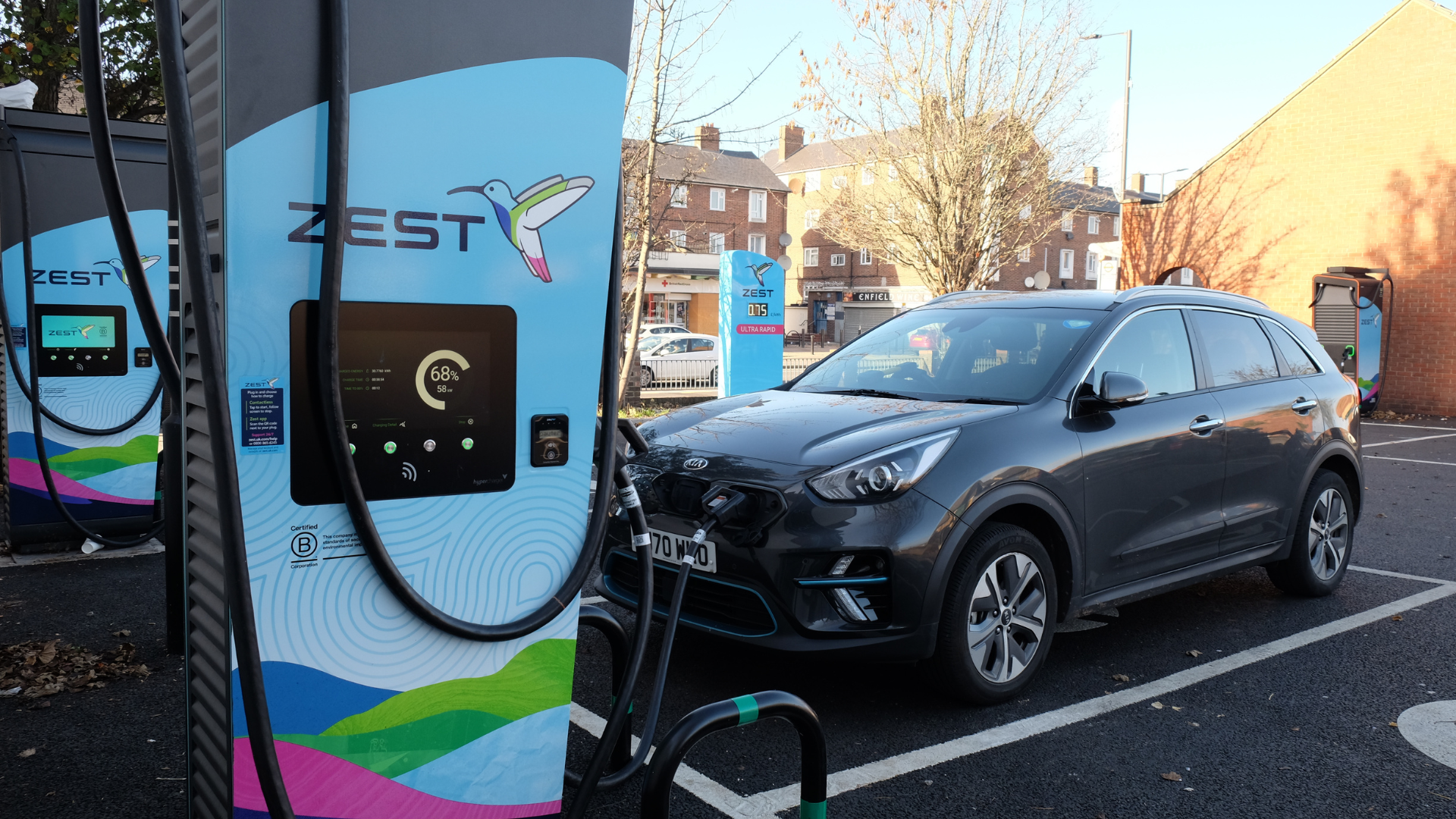
Driver plugging in at a Zest EV charging hub.

You get home from work, park on the street outside your terraced house, and walk inside. No garage. No driveway. Just a front door, a pavement, and a car that needs charging.
Two years ago, that was enough to kill the idea of buying an electric car. Not anymore.
Around nine million UK households don’t have off-street parking. That’s roughly a third of the country, according to EVA England. For years the car industry’s answer was “just install a home charger” — not so helpful advice if your front door opens onto a pavement. But the infrastructure has finally caught up with reality. We now have 116,729 public EV chargers across 45,242 locations (Zapmap, January 2026), up from 102,771 at the end of 2024. Cross-pavement technology is getting proper government funding for the first time. And the UK officially has nearly double the number of EV chargers as petrol and diesel pumps — 116,052 versus an estimated 60,802, confirmed by the Department for Transport in January 2026.
Here’s what actually works.
On-Street Charging: Slow, Cheap, and Getting More Common
Lamp post conversions and dedicated bollard chargers on residential streets are the simplest solution. Plug in overnight at 5–7kW, pick up 25–30 miles of range, unplug in the morning. Not fast. Doesn’t need to be.
Pricing sits between 30–50p per kWh depending on your council and operator. Compare that to a dedicated home EV tariff — 7–10p overnight from suppliers like Octopus or OVO — and yes, you’re paying more. But it’s still significantly less than rapid public chargers at 65–79p per kWh. For most people’s daily mileage, that gap between on-street and home charging works out at maybe £20–30 a month. Not nothing, but not the barrier people imagine.
Coverage is the real problem. It varies enormously depending on where you live. Hackney has 2,500 chargers across seven square miles — a deployment Zest delivered that’s become a national benchmark. Portsmouth has 300+ residential chargers and Dorset has 105 units spread across 50 locations. But plenty of councils have barely started, which is why it’s worth checking Zest’s charging station map or Zapmap before assuming there’s nothing near you.
How to Get Chargers on Your Street
Most councils accept requests from residents for EV charging on specific streets. Some have online portals; others take email enquiries to the highways department. One request rarely shifts anything. Five from the same street, or a neighbourhood petition with 20 signatures, gets attention.
Money isn’t the blocker anymore. The Local EV Infrastructure (LEVI) Fund — £381 million from central government (£343 million for chargepoints, £37.8 million for capability building) — is flowing to tier 1 authorities in England. First installations went live in September 2025. If your council hasn’t started spending it, they should be hearing from you.
What Charging Actually Costs Without a Driveway
Everyone asks this. Few articles answer it with numbers. Here’s a realistic breakdown for someone covering 8,000 miles a year (the UK average) in an EV that does 3.5 miles per kWh.
.jpg)
Most drivers without driveways end up somewhere in the middle, blending on-street overnight charging with the occasional top-up at the supermarket or workplace and a rapid session when they need it. A realistic monthly figure for that kind of mix is £50–80 — more than a driveway owner with a home charger, but still less than half what you’d spend on petrol for the same mileage.
Community Charging Hubs
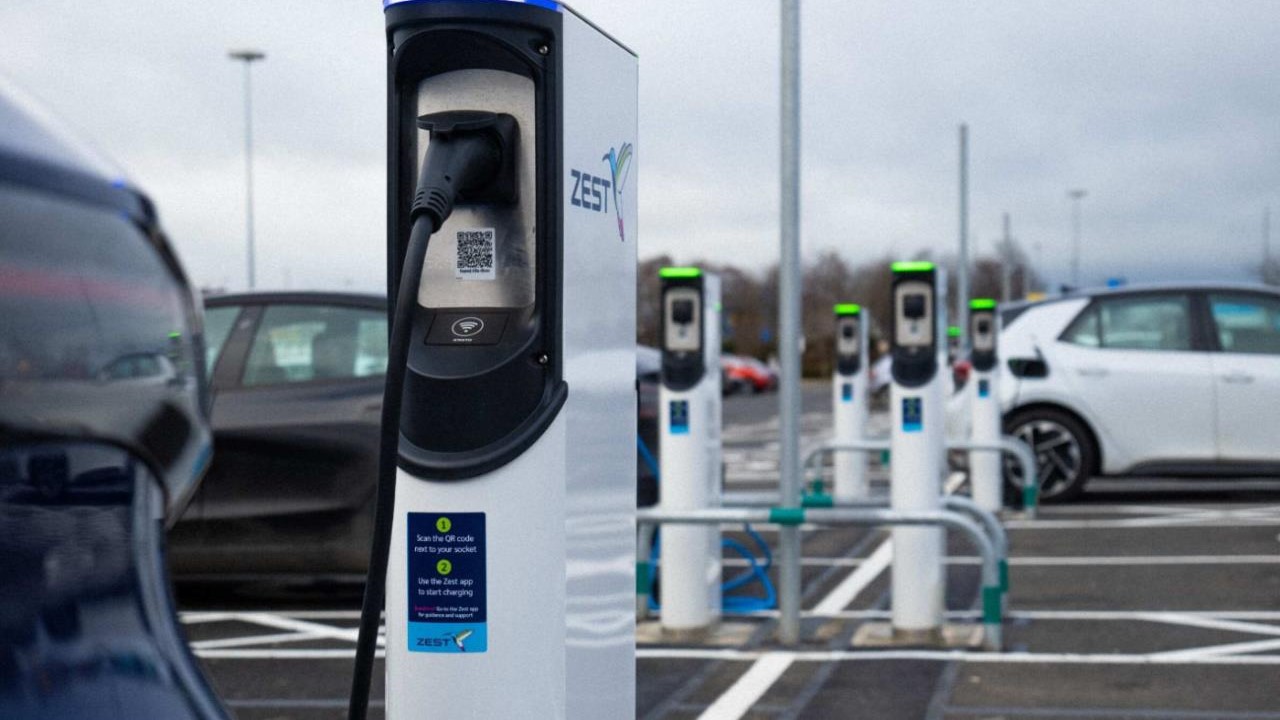
Purpose-built hubs with 6–20+ bays are appearing in residential areas — on council land, in existing car parks, on repurposed brownfield sites. Drop the car off. Plug in. Walk home.
Zest’s Leicester hub on Uppingham Road is a good example. Former car wash site. Ten bays, speeds up to 300kW, 65p per kWh. The Birmingham Jewellery Quarter hub went bigger — 16 bays on the site of the old Hockley Rail Station at the same speed and price. Both accept contactless payment, the Zest app (charging history and VAT receipts available), or platforms like Octopus Electroverse and Allstar.
What makes these different from a motorway services rapid charger is location — they’re near residential neighbourhoods. A 300kW charger adds 100+ miles in about 15 minutes. If your nearest on-street lamp post is slow and unreliable, a hub a short drive away doing 300kW might be the smarter option.
%20(5).jpg)
Charging Where You Already Go
Most people underestimate how much charging you can pick up without trying.
A 7kW charger at the supermarket adds around 25 miles while you do the weekly shop. Three gym sessions a week with 22kW chargers? That covers 200+ miles of range — sorted without ever making a dedicated charging trip. Then there’s workplace charging, which might be the single most practical option for anyone without a driveway — your car sits at work for eight hours, and even a slow 7kW unit adds over 50 miles in that time. Zest operates chargers at retail and leisure destinations across the UK, from shopping centres to hospitality venues.
Worth flagging: the Workplace Charging Scheme grant goes up from £350 to £500 per socket from April 2026, covering up to 40 sockets across all of an employer’s sites. Businesses, charities, and public sector organisations qualify. If your workplace doesn’t have chargers, point whoever handles facilities at the OZEV grant page. It’s free money going unclaimed.
Public Charging Speeds: What to Expect
.jpg)
Ultra-rapid is where the momentum is. In 2025 alone, 3,425 chargers at 150kW or above were added to the UK network — a 40% year-on-year increase, according to Zapmap. That’s the difference between a 45-minute wait and a 15-minute stop.
Every EV Charging Grant Available Right Now
.jpg)
The EV Chargepoint Grant increase from £350 to £500 takes effect 1 April 2026 and covers roughly half a typical installation. The government described this as a “final year extension” running to March 2027. Don’t wait.
Your Rights at Public Chargers
If you relied on public charging two years ago, you know the pain. Broken chargers, hidden pricing, apps that didn’t work. The Public Charge Point Regulations 2023 changed that.
.jpg)
That 99% reliability target has teeth. It’s measured network-wide, the data is public since January 2026, and chargers sitting permanently “out of service” should become rare. Contactless payment means you don’t need five apps to charge your car. Dedicated apps like the Zest app still offer features including charging history and VAT receipts — but the days of needing one are over.
A Typical Week Without a Driveway
Theory is useful. Practice is more convincing.
Take someone in a terraced house who drives 35 miles a day — commuting and errands — in an EV doing 3.5 miles per kWh. That’s about 70kWh a week, or 245 miles.
If their workplace has 7kW chargers (increasingly common), plugging in for eight hours a day gives them 56kWh over a working week. That’s 195 miles from workplace charging alone, covering the weekday commute with room to spare. A Saturday supermarket shop with a 7kW destination charger adds another 25 miles during the time it takes to do the weekly shop. Sunday? Nothing to do. Battery’s above half.
No dedicated charging trips. No queuing at a rapid hub. No stress. And if workplace charging isn’t an option, swap it for overnight on-street charging — the maths still works, it just costs a bit more per kWh. The point isn’t that there’s one perfect solution for everyone without a driveway. It’s that there are now enough decent options to make the whole thing work without much effort.
What’s Coming Next
The £381 million LEVI Fund is rolling out across England. The EV Chargepoint Grant jumps to £500 in April, and the £25 million cross-pavement fund is moving through local authorities. Meanwhile, competition between charge point operators is pushing prices down, reliability up, and coverage into areas that were empty two years ago.
Zest’s network alone covers over 1,300 locations across the UK, all on 100% renewable energy. Everything from 7kW destination chargers at retail sites to 300kW ultra-rapid hubs in residential areas. For local authorities exploring residential charging, Zest’s fully funded model means zero capital cost for your council — Zest owns, installs, and maintains the infrastructure.
Three years ago, no driveway meant no EV. That barrier is gone. The infrastructure exists, the funding is live, and the gap between driveway owners and everyone else is closing fast. If you’ve been waiting, there’s not much left to wait for.
New to EV charging? Zest’s beginner guide covers connectors, payment, and what to expect at a public charger. For the technical detail, the guide to how charging works breaks it down without jargon.
.png)